



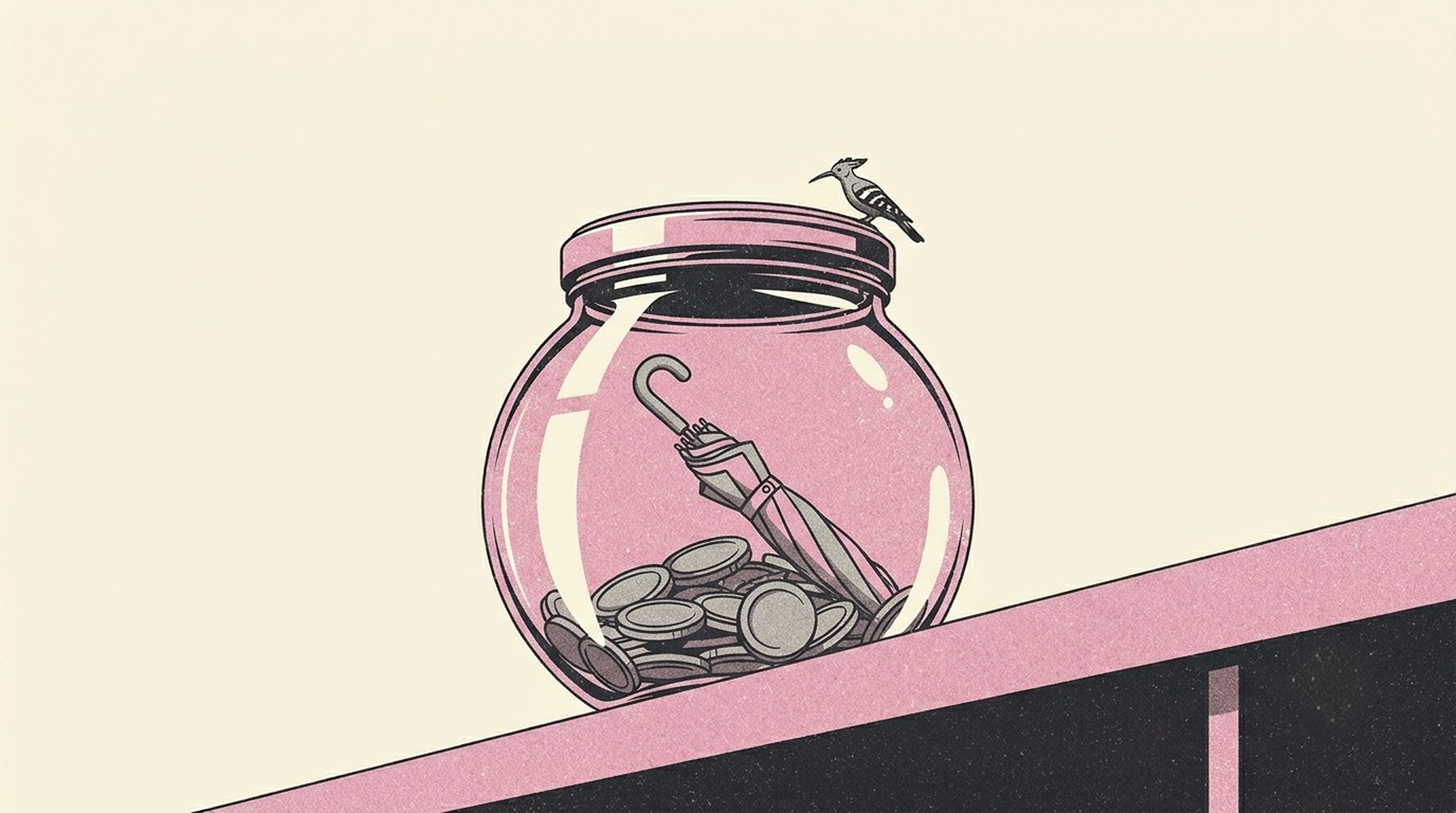
Do you feel guilty every time you look at your bank account?
Picture the scene: you are standing in front of the mirror in the morning, getting ready for the day, and suddenly yesterday's purchases come back to you. The café you didn't actually need. The clothes you bought "because it was necessary" that are still hanging in the wardrobe. The paid app you opened once.
You know the feeling.
Most of us live in the same loop: spend, regret, decide that "tomorrow I'll start saving properly this time." Tomorrow arrives, passes, and the cycle repeats. The question that follows us around is this: how do you save well without feeling like you are punishing yourself?
The truth is the problem isn't your wish to enjoy your life. The problem is how we think about money and saving.
What saving actually is
Before going further, let's agree on one thing: saving is not the enemy trying to steal your enjoyment.
Saving is setting aside a portion of your income and deferring its use from the present to the future. It can be compulsory, such as pension deductions, or voluntary, which is the part that matters here.
Here is the part people miss: saving is not a goal in itself. We don't save for the sake of saving, we save because it is the bridge to our real goals. Think of it as a seed planted today for a harvest later.
Why most saving attempts fail
"The problem isn't that I spend too much, it's that I don't know how to spend right."
That sentence can change how you see this entirely. Most of us think the answer is to spend less. The answer is actually to spend better.
When you focus only on "spend less," what happens:
- You feel deprived and resentful
- You live under constant psychological pressure
- You hit a breaking point and spend wildly
- You feel like a failure
- You give up and conclude that saving isn't for you
When you focus on "spend smarter," the result is different:
- You feel satisfied with your financial decisions
- You spend less without feeling deprived
- You focus on real priorities
- You keep going long term
- You feel in control and confident
Why saving matters more than you think
1. Sleeping properly, and this is not a metaphor. When was the last time you woke at 2am worried about a bill or an unexpected cost? Having savings means quiet sleep, steady nerves, and confidence that you can face a surprise. This isn't philosophy, it is psychology. Financial anxiety affects your health, your relationships, and your performance at work. Savings equal peace of mind.
2. The power of saying no. Picture a job interview where the manager offers less than you expected. With no savings, you accept whatever is on the table. With a financial cushion, you can say "no, thank you" and look for a better opportunity. Savings give you the power to choose rather than the obligation to accept.
3. Turning crises into manageable events. How do you save for emergencies? That question should not be asked during the crisis, it should be answered years earlier. The sudden time off, the home repair, the illness: these will happen. The difference between someone with savings and someone without is the difference between facing the crisis and drowning in it.
4. Buying freedom, literally. Saving buys you something you cannot price: freedom. Freedom to take a holiday without guilt, freedom to buy a gift for someone you love, freedom to try a new project, freedom to say no to what doesn't suit you.
5. Facing the silent inflation. Every day you delay saving, your money loses value. Inflation is a quiet thief that takes from your pocket without your noticing. Saving and investing are the only protection against it.
How to balance enjoyment and responsibility
"I want to save, but I also want to live."
That is not an impossible equation. It just needs rewriting.
The problem is in the thinking, not in the amount. The problem is not that you spend a lot, it is that you spend without awareness. The difference between someone who saves well and someone who doesn't is not income size, it is how they handle money.
Focus on quantity alone ("I have to cut my spending") and you enter a psychological fight with yourself. Focus on quality ("I have to spend on what actually matters") and you feel in control and satisfied.
The key: tie spending to your values. This is one of the most useful ideas here. Connect every expense to one of your core values.
A simple test:
- If health matters to you, does it make sense to spend on fast food and hold back on a gym membership?
- If learning matters, does it make sense to hesitate over a 500 EGP 🇪🇬 course while buying a 50 EGP 🇪🇬 coffee every day?
- If family is the priority, is the expensive dinner better, or the annual trip together?
Questions that help you re-sort your priorities:
- What are the most important values in your life?
- How can money serve those values?
- Which expenses align with your values, and which conflict with them?
- How could you express your values more effectively in financial terms?
Your practical guide to smart saving
Step 1: Define your goals, and be very specific. Don't say "I want to save money," say "I want to save 50,000 EGP 🇪🇬 over 2 years for the deposit on a flat." Vague goals produce vague results. Clear goals produce clear plans.
Questions that help: how much exactly is needed, when do you need it, and how much do you have to save monthly to get there?
Step 2: Build a budget you can live with, not fight against. A perfect budget you cannot follow is worthless. The 50/30/20 rule is a starting point: 50% for essentials such as housing, food, transport, and bills, 30% for wants such as entertainment, hobbies, and restaurants, and 20% for saving and investing. Adjust the split to your own circumstances.
Step 3: Pay yourself first. Instead of waiting until the end of the month to see what's left, take the saving amount out at the start. Treat it as a compulsory bill, like electricity. In practice: set the monthly saving amount, set up an automatic transfer to a separate account, and live on the rest.
Step 4: Know where your money goes. Track your spending for a full week, every single item. The result will surprise you. Ask yourself where the largest share goes, which purchases you regret, and which "small" costs are quietly stacking up.
Step 5: Build a reward system. How do you save and enjoy yourself at the same time? Reward the wins. If you held to the budget for a month, give yourself something modest: a film, a good meal, a new book.
Making it a lifetime habit
1. Start small, think big. Don't try to save 50% of your salary in month 1. Start at 5%, or even a fixed small amount. The goal is building the habit, not breaking a record.
2. Automate it. The easiest way to stay committed is to remove the decision. An automatic transfer means no daily choice to make, the habit runs itself.
3. Celebrate the small wins. Reached your first 10,000 EGP 🇪🇬? Celebrate. Reached 50,000? Celebrate more. Celebration builds the motivation to continue.
4. Remember why you started. In the hard moments, remember the goal. Is it security? Freedom? Your children's future? Remembering the reason is what keeps you going.
 Conclusion
Smart saving is not about living a smaller life, it is about living a smarter one. It is not about deprivation, it is about conscious choice.
The value of saving isn't in the amount you accumulate, it is in the confidence you build, the freedom you buy, and the future you secure. What we shared here isn't only financial advice, it is a way of living that puts you in the front seat of your own financial life.
And remember: the question is not "how do I save money?" It is "how do I live the life I want with the money I have?" The answer is in your hands, and the time is now. Start today, start small, but start.

PhD in Islamic Economics & Banking and a certified CSAA (Certified Shari'ah Advisor & Auditor)
Read also

Navigate Financial Freedom with Chess Mindset
End the cycle of spending guilt and learn how to manage your finances with a simple, stress-free plan.
 6 min read

Your Route to Financial Freedom: A Glossary of the Concepts That Get You There
Financial literacy is one of those phrases that sounds impressive and explains nothing on its own. This article maps the core concepts you need in your toolkit, from opportunity cost to emergency funds, and it is updated continuously.
5 min read

Ramadan: A Practical Reset for Your Financial Habits
Ramadan is meant to be a month of restraint, yet it has quietly become one of the heaviest spending seasons of the year. This article turns the month into a structured reset for your financial habits, from planning the food budget to giving deliberately and leaving Ramadan without new debt.
8 min read
Download the app now!
Read more through the Xeer app. Download it now and enjoy all Xeer features.
 Download the App

Read also
Beyond "BNPL": The Real Cost of Consumer Installment Finance
Consumer installment finance doesn't just affect the people using it, it reshapes spending behavior, market pricing, and economic stability at scale. This article traces the real cost of BNPL from the individual decision all the way to the broader market, and what to do with that understanding.
 Ahmed El Zoughby
8 min read
Ahmed El Zoughby
8 min read
Traditional Installments & Commercial BNPL through the lens of Islamic Finance
Installment finance in Egypt takes more than one form, and the differences between them are not in the marketing, they're in the structure. This article breaks down some of those commercial models, what each one hides, and where each one stands against the sharia compliance standards.
Ahmed El Zoughby
7 min read
Buy Now, Pay Later: How Consumer Finance Became Part of Egyptian Life
Consumer installment finance in Egypt is no longer a niche product, it is infrastructure. Understanding what's driving this growth, and what the numbers behind it actually mean, is the starting point for any informed financial decision.
Ahmed El Zoughby
3 min read