



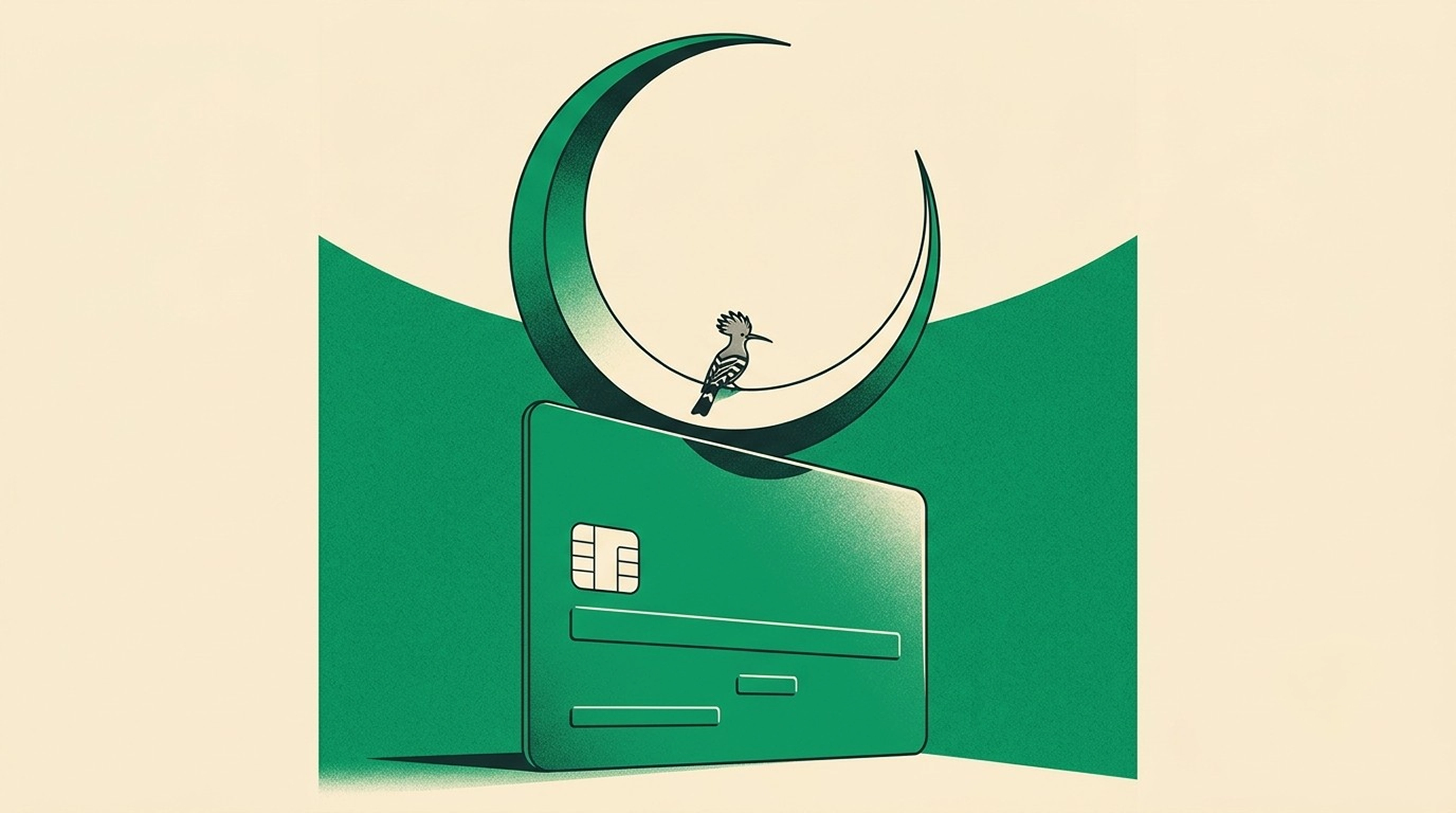
Not all credit cards are created equal. For anyone seeking to keep their finances Sharia-compliant, the debt model, the contract mechanism, and the card's backing are among the most critical factors in determining a credit card's Sharia-compliance status.
Step 1: Always Start with an Islamic Bank
This is an essential starting point:
- An Islamic bank operates under a Sharia supervisory board, and its products go through Sharia review and approval
- The bank will usually restrict the card from buying products and services widely agreed to be prohibited, such as alcohol and gambling
- Conventional banks with "Islamic windows" come second: they may offer compliant products, but they don't operate on Islamic finance principles across the whole institution
- Look for banks that publicly disclose their Sharia board members and publish the board's rulings and reports on their products
Step 2: The Debt Model
A. There is usually a debt window of up to 57 days, after which you're asked to settle the full amount or the minimum, often 5%. The problem appears when only the minimum is paid: the debt stays and grows month over month, carrying riba-based interest at conventional banks, or profit and fees at Islamic banks depending on the contract in use. Unfortunately this may be the only option available to you in most countries.
B. [Best option] Some Islamic banks call the card a "Charge Card" and drop the term credit entirely. Some go as far as requiring the minimum payment within the grace period to be 100% of the balance. That is excellent, because it completely prevents the cycle of compounding monthly interest familiar from conventional banks and most other Islamic banks, and the bank treats the card here as a short-term loan. If you find this option available, take it without hesitation. It is not only the Sharia-compliant choice, it also stops you sliding into a growing debt you can't control.
Step 3: Backing the Card with Cash
- Set the credit limit that fits your budget, not the maximum the bank offers, and pick a limit that covers your need without opening a door to spending
- Set aside an amount equal to the card limit, or covering most of it, and keep it as a reserve for repayment when you need it or when things get tight
- Deposit it in a Sharia-compliant product: a savings certificate, sukuk, or an investment deposit at the same bank
This amount is your financial backing, not your spending source. You reach for it in an emergency so you don't fall into debt - This approach is better because credit exposure risk is removed entirely: you always have the liquidity to pay under the tightest circumstances, without carrying a balance. And even if the bank runs tawarruq in the background, it never gets triggered against you. You also build a disciplined credit history without entering a debt cycle.
Step 4: Contract Mechanisms
Not all Islamic cards rely on the same contract mechanism. Know what you are signing up for:
A. Ujrah (Service Fees) [Best Approach]: Fixed annual or monthly fees instead of interest (paired with the 100% minimum payment structure). This is the structure most compliant with Sharia law.
B. Organized Institutional Tawarruq: The bank relies on relatively low fees alongside the ujrah, but it conducts a process called "organized institutional tawarruq" to support the product's profitability for the bank. Here, the bank arranges and executes the purchase and sale of a commodity (usually platinum) on your behalf, liquidating its value for you as backing for a monthly profit-rate murabaha installment plan. The International Islamic Fiqh Academy ruled this impermissible in Resolution No. 179 (19th Session, 2009), on the basis that no real transfer of ownership or risk occurs, making it effectively an usurious loan. Exir aligns with the Academy's standards.
Crucial Note: Many Islamic banks use tawarruq as a mechanism triggered after debt occurs. Meaning, if you do not roll over any balance beyond the end of the grace period, while relying on backing your card with cash liquidity, the tawarruq will not be activated and becomes irrelevant to your situation.
For Context: Individual Tawarruq: This is when you buy a commodity on deferred payment terms and then sell it yourself to a third party for immediate cash. Through this, you obtain immediate liquidity to pay in installments with a markup,this way it is procedurally permissible. Despite opposing views in the Maliki school and among some classical scholars, the majority of contemporary schools and scholars permit it, usually on the condition of actual need and the absence of organized collusion between the parties.
Step 5: After Getting the Card
In every case, treat the card as the bank's money, even if it is Sharia-compliant. Debt is debt under all circumstances, which is why the following golden rules matter:
- Only use it within what you already have, and treat it like a debit card
- Always settle in full before the grace period ends, and never carry a balance into the next month
- Avoid cash advances entirely, because they usually run on a different mechanism and can raise Sharia issues and extra fees regardless of card type
- Don't use it as an emergency reserve, that's what savings are for
Make sure your financial personality treats debt as a tool for reaching your goals, not one that pushes you away from financial freedom, whether the card is Sharia-compliant or not. Not sure? Read the next article: "Is a Credit Card Right for Your Financial Personality?"
 Conclusion
An Islamic credit card, used with clarity and commitment, serves your needs without compromising your values. And if you're still assessing your readiness, we've an article in this credit card series to have a good starting point on defining your Financial Personality traits.

A product expert, the co-founder, and CEO of Xeer, a personal finance management platform built on Islamic Sharia principles. His work sits where Sharia fintech meets everyday money practices. He writes in Jarida to put financial awareness within reach of every Arabic speaker.
Read also

Navigate Financial Freedom with Chess Mindset
End the cycle of spending guilt and learn how to manage your finances with a simple, stress-free plan.
 6 min read

Your Route to Financial Freedom: A Glossary of the Concepts That Get You There
Financial literacy is one of those phrases that sounds impressive and explains nothing on its own. This article maps the core concepts you need in your toolkit, from opportunity cost to emergency funds, and it is updated continuously.
5 min read

Ramadan: A Practical Reset for Your Financial Habits
Ramadan is meant to be a month of restraint, yet it has quietly become one of the heaviest spending seasons of the year. This article turns the month into a structured reset for your financial habits, from planning the food budget to giving deliberately and leaving Ramadan without new debt.
8 min read
Download the app now!
Read more through the Xeer app. Download it now and enjoy all Xeer features.
 Download the App

Read also
Beyond "BNPL": The Real Cost of Consumer Installment Finance
Consumer installment finance doesn't just affect the people using it, it reshapes spending behavior, market pricing, and economic stability at scale. This article traces the real cost of BNPL from the individual decision all the way to the broader market, and what to do with that understanding.
 Ahmed El Zoughby
8 min read
Ahmed El Zoughby
8 min read
Traditional Installments & Commercial BNPL through the lens of Islamic Finance
Installment finance in Egypt takes more than one form, and the differences between them are not in the marketing, they're in the structure. This article breaks down some of those commercial models, what each one hides, and where each one stands against the sharia compliance standards.
Ahmed El Zoughby
7 min read
Buy Now, Pay Later: How Consumer Finance Became Part of Egyptian Life
Consumer installment finance in Egypt is no longer a niche product, it is infrastructure. Understanding what's driving this growth, and what the numbers behind it actually mean, is the starting point for any informed financial decision.
Ahmed El Zoughby
3 min read