



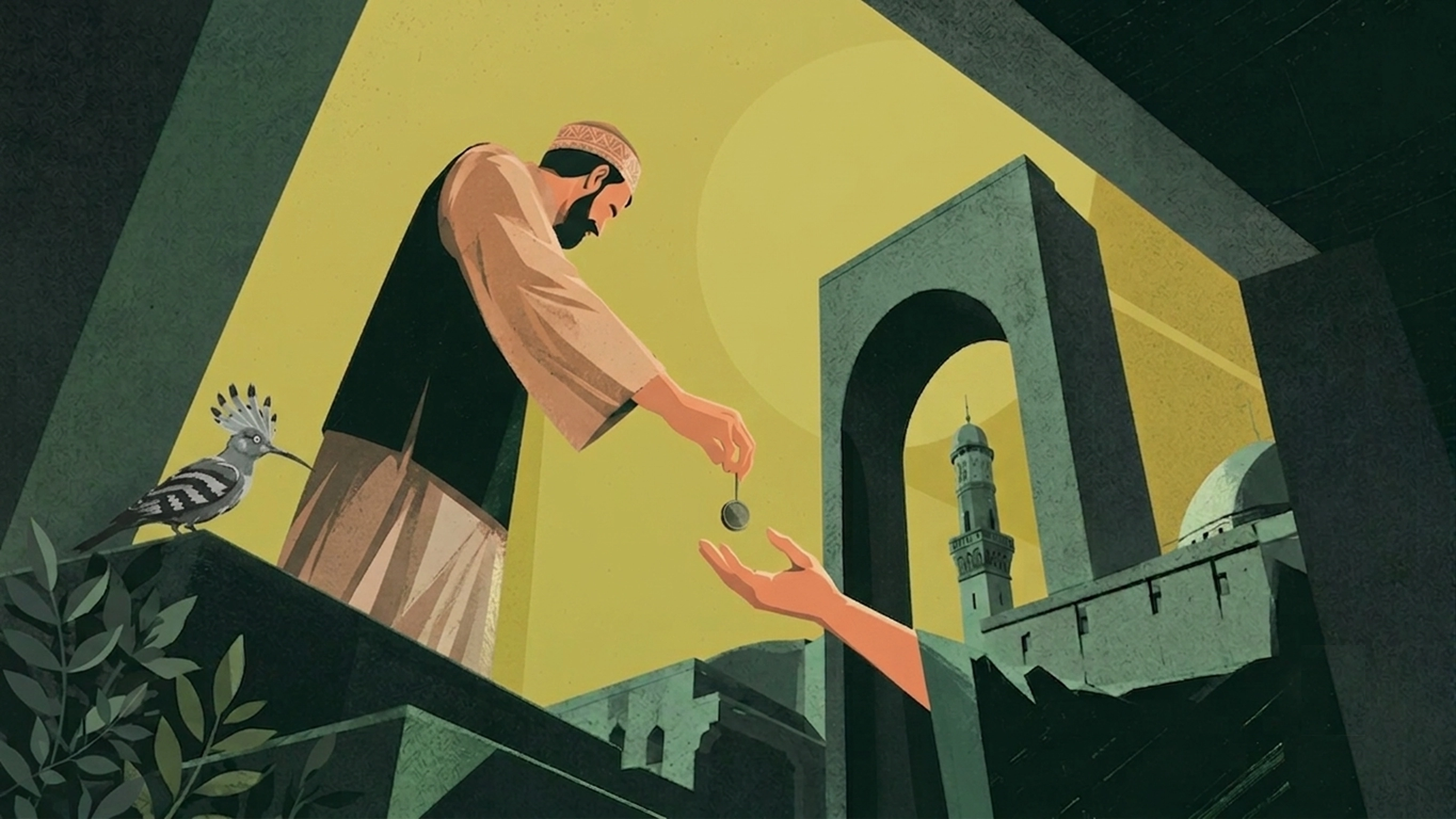
Throughout history, money has remained one of the most powerful forces shaping human decisions. Yet this is neither inherently good nor evil — wealth is a tool that grants its holder the capacity to build or destroy, to give or withhold, to show mercy or to transgress.
Against the weight of money's influence in our lives, Zakat came to place it in its rightful position: a means, not an end — an instrument of flourishing, not accumulation. The essence of Zakat is not simply a sum paid once a year; it is a divine message directed at every person of wealth, telling them that blessing is measured by what you give, not by what you hold.
Zakat is not merely a financial act of worship between you and Allah — it is a complete system that governs your relationship with yourself, with those around you, and with wealth itself. It establishes that faith is incomplete without a social imprint, and that true prosperity begins the moment you give.
First: The Linguistic and Sharia Meaning of Zakat
Zakat is not merely a financial term — it is a Quranic word carrying deep spiritual and ethical dimensions. Linguistically, Zakat revolves around two meanings: purification and growth.
Zakat purifies the soul from miserliness and attachment to wealth, cleanses wealth from any impurity or doubt that may have crept in unintentionally, and purifies society from envy and class division. At the same time, it grows wealth — not in the material sense of adding numbers, but through its blessings, its stability, and its lasting extension into goodness.
In Sharia terminology, Zakat is a mandatory financial right in specific wealth, when defined conditions are met and a full lunar year has passed, given to categories Allah designated in the Quran. It is an act of worship prescribed for specific assets under specific conditions — including complete ownership and reaching the Nisab — paid after a full Hijri year has elapsed since the Nisab was reached, and distributed to eight designated categories, transferring ownership completely from the payer to the recipient. Zakat is neither a gift nor voluntary charity.
Many people confuse Zakat with Sadaqah. The distinction is clear:
- Zakat: The third pillar of Islam. A mandatory act of worship paid at a specific ratio, at a specific time, to Quranically designated categories. It is obligatory on everyone who meets the conditions.
- Sadaqah: A voluntary act of worship with no fixed amount, timing, or designated recipients — it may even benefit animals or plants, and can be material or immaterial such as a kind word. It is encouraged for both rich and poor alike.
Zakat is the irreducible minimum of giving that no believing Muslim of Sharia-recognized wealth may neglect or overlook. Sadaqah is a door of goodness that stands open to everyone in countless forms.
Second: Zakat Is a Pillar of Islam
When the Prophet ﷺ was asked about Islam, he answered clearly: "Islam is built on five: testimony that there is no god but Allah and that Muhammad is His messenger, establishing prayer, giving Zakat, fasting Ramadan, and pilgrimage to the House." (Agreed upon)
Zakat is the third pillar of Islam after the two testimonies and prayer. It is paired with prayer in numerous Quranic verses — as though spiritual balance cannot be complete without both:
﴿وَأَقِيمُوا الصَّلَاةَ وَآتُوا الزَّكَاةَ وَارْكَعُوا مَعَ الرَّاكِعِينَ﴾
Sahih International: "And establish prayer and give zakah and bow with those who bow [in worship and obedience]." — Al-Baqarah 2:43
Allah warned those who withhold Zakat with severe worldly and otherworldly consequences:
﴿وَالَّذِينَ يَكْنِزُونَ الذَّهَبَ وَالْفِضَّةَ وَلَا يُنفِقُونَهَا فِي سَبِيلِ اللَّهِ فَبَشِّرْهُم بِعَذَابٍ أَلِيمٍ﴾
Sahih International: "And those who hoard gold and silver and spend it not in the way of Allah — give them tidings of a painful punishment." — At-Tawbah 9:34
Abu Bakr Al-Siddiq, may Allah be pleased with him, fought those who withheld Zakat after the Prophet's death, saying: "By Allah, I will fight those who differentiate between prayer and Zakat."
Third: Why Did Allah Prescribe Zakat?
Allah does not need our wealth. But society, individuals, and wealth itself all do. The wisdom behind Zakat can be summarized as follows:
- Purifying the soul: The desire to possess takes root in the human soul — wealth shifts from a means into an idol if one's relationship with it goes unrefined. Zakat breaks the obsession with ownership and uproots selfishness from the heart:
﴿وَمَن يُوقَ شُحَّ نَفْسِهِ فَأُولَٰئِكَ هُمُ الْمُفْلِحُونَ﴾
Sahih International: "And whoever is protected from the stinginess of his soul — it is those who will be the successful." — At-Taghabun 64:16
Repeated giving trains the soul toward generosity, trust in divine provision, and genuine compassion for others.
- Purifying wealth: Despite our care to earn lawfully, some impurity may enter wealth unintentionally. Zakat cleanses it. The Prophet ﷺ said: "Wealth is never diminished by charity." (Muslim)
- Achieving social justice: Islamic law did not leave wealth accumulating in the hands of a few. Zakat distributes wealth in a way that preserves the dignity of the poor, reduces economic gaps, and moves people from dependence to productivity — through a recurring annual system designed for lasting effect.
- Strengthening social solidarity: Zakat builds a cohesive fabric in which no poor person, widow, orphan, or debtor is abandoned. It reinstates the principle that every individual carries responsibility for those around them — and redefines what it truly means to feel for others.
Fourth: Zakat Is Not a Tax
When people hear about a mandatory financial deduction, many instinctively think "tax" — a common and inaccurate conflation. The fundamental differences are significant:
- Source and intention: Zakat is a divine command performed by the Muslim as an act of worship, for which the payer is rewarded by Allah. A tax is human legislation imposed by states as a primary revenue mechanism with no spiritual dimension whatsoever.
- Who it applies to: Zakat is obligatory exclusively on the wealthy. Taxes are collected regardless of the payer's financial condition.
- Where it goes: Zakat has eight designated categories set by Allah in the Quran — it cannot be directed elsewhere. Taxes fund general state affairs.
- Its effect: Zakat blesses wealth, eases the soul, and achieves social justice. It can be evaded in this life, but the evader remains accountable before Allah. Taxes burden people, and the wealthy often find avenues to avoid them.
Zakat is not merely a worship performed once a year — it is a way of life accompanying the Muslim through all economic, social, and spiritual stages. It is a test of the sincerity of faith and trust in Allah.
 Conclusion
Zakat is a practical declaration that wealth is not your master — it is a servant fulfilling Allah's will. The wealthy person's wealth is Allah's trust in their hands; they do not bestow a favor on the poor — Zakat is a right that belongs to the poor in the wealthy person's wealth. Zakat is a moment of truth between you and Allah, as if you say: "My Lord, this is Your wealth. You honored me with it, and here I place it where You commanded."

PhD in Islamic Economics & Banking and a certified CSAA (Certified Shari'ah Advisor & Auditor)
Read also

Navigate Financial Freedom with Chess Mindset
End the cycle of spending guilt and learn how to manage your finances with a simple, stress-free plan.
 6 min read

Your Route to Financial Freedom: A Glossary of the Concepts That Get You There
Financial literacy is one of those phrases that sounds impressive and explains nothing on its own. This article maps the core concepts you need in your toolkit, from opportunity cost to emergency funds, and it is updated continuously.
5 min read

Ramadan: A Practical Reset for Your Financial Habits
Ramadan is meant to be a month of restraint, yet it has quietly become one of the heaviest spending seasons of the year. This article turns the month into a structured reset for your financial habits, from planning the food budget to giving deliberately and leaving Ramadan without new debt.
8 min read
Download the app now!
Read more through the Xeer app. Download it now and enjoy all Xeer features.
 Download the App

Read also
Beyond "BNPL": The Real Cost of Consumer Installment Finance
Consumer installment finance doesn't just affect the people using it, it reshapes spending behavior, market pricing, and economic stability at scale. This article traces the real cost of BNPL from the individual decision all the way to the broader market, and what to do with that understanding.
 Ahmed El Zoughby
8 min read
Ahmed El Zoughby
8 min read
Traditional Installments & Commercial BNPL through the lens of Islamic Finance
Installment finance in Egypt takes more than one form, and the differences between them are not in the marketing, they're in the structure. This article breaks down some of those commercial models, what each one hides, and where each one stands against the sharia compliance standards.
Ahmed El Zoughby
7 min read
Buy Now, Pay Later: How Consumer Finance Became Part of Egyptian Life
Consumer installment finance in Egypt is no longer a niche product, it is infrastructure. Understanding what's driving this growth, and what the numbers behind it actually mean, is the starting point for any informed financial decision.
Ahmed El Zoughby
3 min read